|
|
|
Meteorology - climate and winds*
Climate
The climate at the Adriatic is typically a Mediterranean
one, with mild rainy winters, and hot and dry summers. The
air temperature changes depending on the area. Thus, summer
temperatures in July will be about 34°C in the northern part,
while in the southern part they will rise even to 38°C. In
the winter, the coldest temperatures are noticed in the northern
Adriatic (up to -16°C), while they will not have exceeded
6°C in the southern part.
Winds
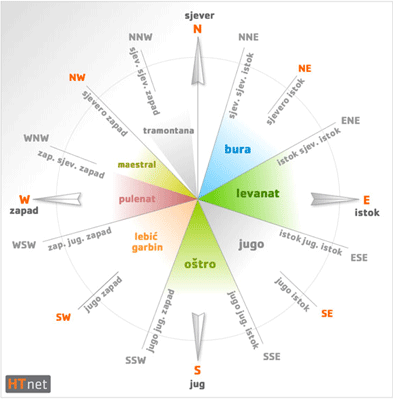
At the Adriatic Sea, the bora, sirocco and north-western
wind blow most often.
Bora
Bora
(Cro.: bura) is a dry, cold downward wind blowing in bursts
from the north-northeast to the east-northeast direction.
The direction in which the wind blows is mostly influenced
by the configuration of the shore. The strength of bora is
explained by the existence of warm air over the surface of
the sea, and a cold layer of air above mountain ranges in
the littoral, which cause a strong streaming due to equating
of the pressure. Cold air tends to fill the void which occurs
due to the rising of the warm (lighter) air from the sea surface.
Bora blows mostly in the winter. In the summer, it usually
lasts for a day or several hours, while, in the winter, it
can blow as long as 14 days.
Sirocco
Sirocco (Cro.: jugo, siroko or silok) is a warm and moist
wind which blows from the direction east-southeast to south-southwest.
Its consequences are high waves and rain. Sirocco is a characteristic
wind for the southern Adriatic, where it blows longer and
stronger than in the northern part. In the summer, it usually
blows as long as 3 days, and in the winter even as long as
3 weeks. The signs of the oncoming sirocco are the calm at
the sea, weak changeable winds, dimness of the horizon, the
increase of the temperature and moisture, and the gradual
decrease of the pressure. Waves from the direction of the
southeast become bigger.
Landward Breeze
The landward breeze (Cro.: maestral, maestral, smorac) is
a daily, thermic wind blowing from the direction of the northwest,
and it occurs as the consequence of the difference in the
speed of warming up of the land and the sea. It is present
from the spring to the autumn, and, during the day, it often
changes the direction of blowing. The landward breeze is more
present in the southern Adriatic than in the northern Adriatic,
and it starts to blow earlier there.
Stiff Breeze
The stiff breeze (Cro.: burin) is a wind blowing contrary
to the landward breeze. It blows during the night from the
direction of the north, north-east in the northern Adriatic,
and in the southern Adriatic, from the east or south-east.
It is the strongest before the dawn, and after that it stops
soon.
Data About Weather
Weather forecasts are made by the State Hydrometeorological
Institute, and they can be heard on VHF frequencies of coastal
radio stations and harbor master's offices. They are also
broadcast on FM stations or at the end of the news or within
broadcasts for seamen. Harbor master's offices constantly
send weather reports and warnings on their VHF operating channels,
in four languages. It is possible to get forecasts with the
presentation of the synoptical situation in all the marinas
and harbor offices.
Nautical Radio Service and Communications
Service
The whole of the Croatian coast is covered by radio communications
rather well. The radio service for protection of human lives
and safety of navigation is provided by Plovput from Split,
through radio stations Split and Dubrovnik, which cover the
southern Adriatic, and Rijeka, which covers the northern part
of our sea.
According to the standards of the GMDSS system (Global Maritime
Distress and Safety System), the channel for automated receipt
of digitalized distress calls is the channel 70, after which
the communication is transferred to the operating channel
of the coastal station, i.e. a harbor master's office (16
or 10). GMDSS system has been in use since 1 st February 1999,
and on the present VHF channel for distress calls, the channel
16, constant listening will be possible still for some more
time.
For a direct call to a harbor master's office, the channel
10 is used.
In Croatia, there are three commercial systems of wireless
telephony: mobile phone 099, Cronet 098 and VipNet 091.
* Text provided by www.croatia.hr
|
|
|